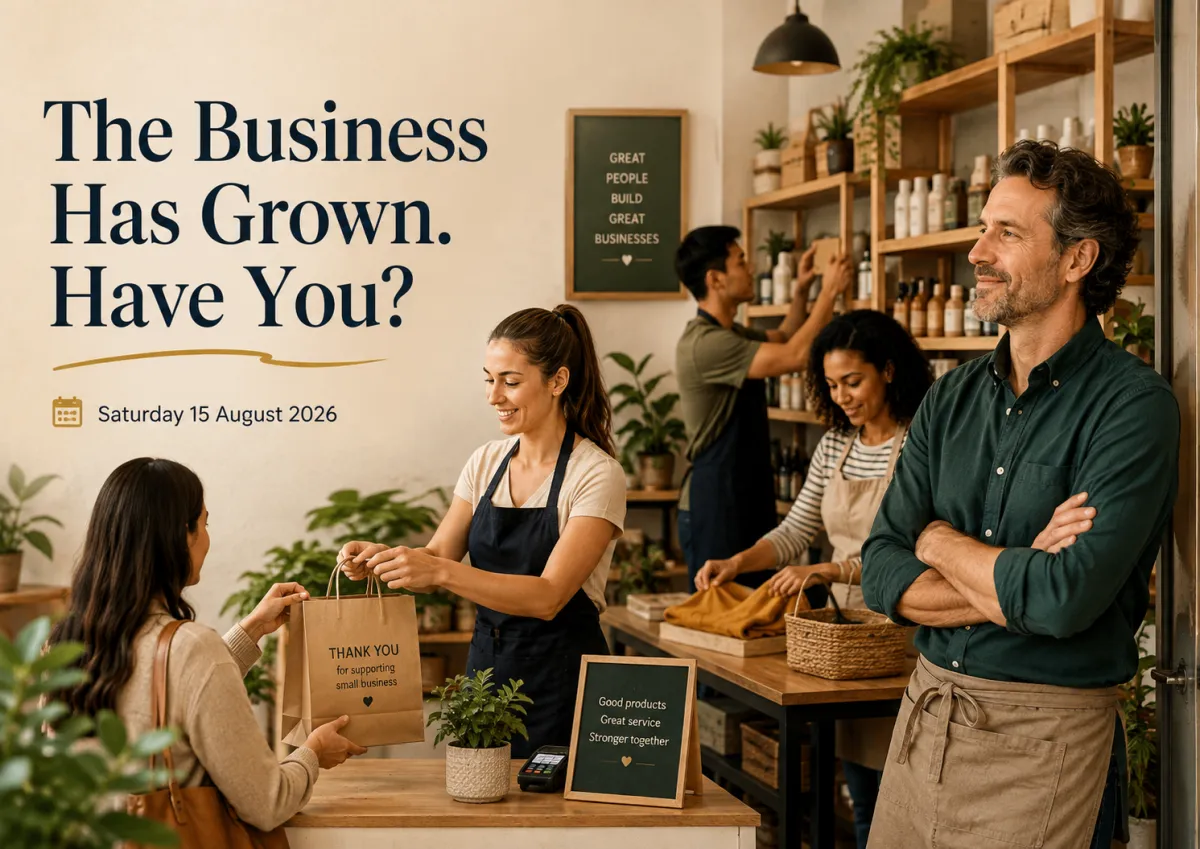
The Business Has Grown. Have You?
A business can grow without the owner's role growing with it.
I saw this with a retailer I worked with some years ago.
The business had employees. Responsibilities had been allocated. On paper, there was a team.
But when something important went wrong, the work had a habit of finding its way back to the owner.
When taking the work back feels safer
But there was another option.
Taking back the work stopped the employee from learning how to do the task better.
Perhaps the owner could have sat beside them for the next order, checked the following couple of purchases, and then gradually handed the responsibility back.
One mistake does not necessarily mean someone is incapable of doing the job.
Sometimes it means they need:
better training
clearer expectations
the right authority
the opportunity to learn
There were other examples in the same business.
When a difficult customer came into the store, staff called the owner.
The owner knew the inventory system inside out. The staff did not, and mistakes were being made.
The business had people in it, but much of the knowledge, authority and decision-making still sat with one person.
And that creates a problem.
When the owner becomes the bottleneck
When an employee makes a mistake, taking the job back may solve today's problem.
It can also create tomorrow's bottleneck.
The more work the owner takes back, the more dependent the business becomes on the owner.
Eventually, the owner becomes:
the person who needs to approve the purchase
the person who knows how the system works
the person who can deal with the difficult customer
the person who has to step in whenever something goes wrong
And while the owner is doing all of that, something else is happening.
The team is not learning.
People do not become more capable if they are never given the opportunity to make decisions, make an occasional mistake, understand the consequences and try again.
Good employees can also become frustrated if they feel they have responsibility in name but very little real authority.
There is a practical business risk as well.
If the owner is the only person trusted to order stock and they become too busy to place the order, the store may eventually have nothing to sell.
What feels like control can turn to dependency.
The same business began to change
But over time, I saw a different version of this in the same business.
The owner gradually stopped:
opening and closing the store every day
doing the banking
automatically coming in every Saturday and Sunday
being the first person called whenever someone was sick
working on the till every day
spending most of their time on the shop floor
That did not happen overnight.
They trained one of the staff members to be responsible for how the store operated.
All the tasks previously done by the owner were still important.
They simply no longer needed to be done by the owner.
As a business grows, the question is not whether a task needs to be done. It is whether it still needs to be done by you.
So what should the owner's role become?
That does not mean the owner disappears from the business.
Quite the opposite.
As a business grows in revenue, operations and team size, the owner's time needs to shift towards tasks that drive and grow the business, including:
understanding the finances
recruiting and developing the right people
planning where the business is heading
setting priorities
building relationships
making the decisions that shape what happens next
And I think owners also need to remain connected to their customers.
You may no longer need to serve every customer personally, but you cannot afford to lose touch with what your customers are experiencing.
Delegation is not about becoming disconnected.
It is about making sure the business can function without every decision and every piece of knowledge sitting with you.
Hiring people is not the same as building a team
Hiring people alone does not create that.
You can employ ten people and still have a business that is completely dependent on its owner.
The real shift happens when:
knowledge is shared
authority is clear
people are developed well enough to make decisions without constantly looking over their shoulder
That can be uncomfortable.
Many owners built their businesses by being the person who knew how to do everything.
They solved the problems.
They dealt with the customers.
They watched the money.
They stepped in whenever something needed fixing.
Those behaviours may have been exactly what the business needed in its early years.
But the things that help build a small business can eventually start constraining a larger one.
At some point, the owner's contribution has to change.
Their value increasingly comes from the decisions they make, the people they develop and the business they are building — not simply from the number of tasks or transactions they complete each day.
So perhaps the question worth asking yourself this week is:
If you're spending all your time working in today's business, who is building tomorrow's business?
Every stage of growth demands a different version of the owner.
The Revenue-to-Value Model™ is a proprietary framework of Towards Growth.
Ready to review whether your current business design still supports what you want to achieve. Explore our insights and strategic resources for business owners at towardsgrowth.com.au.
