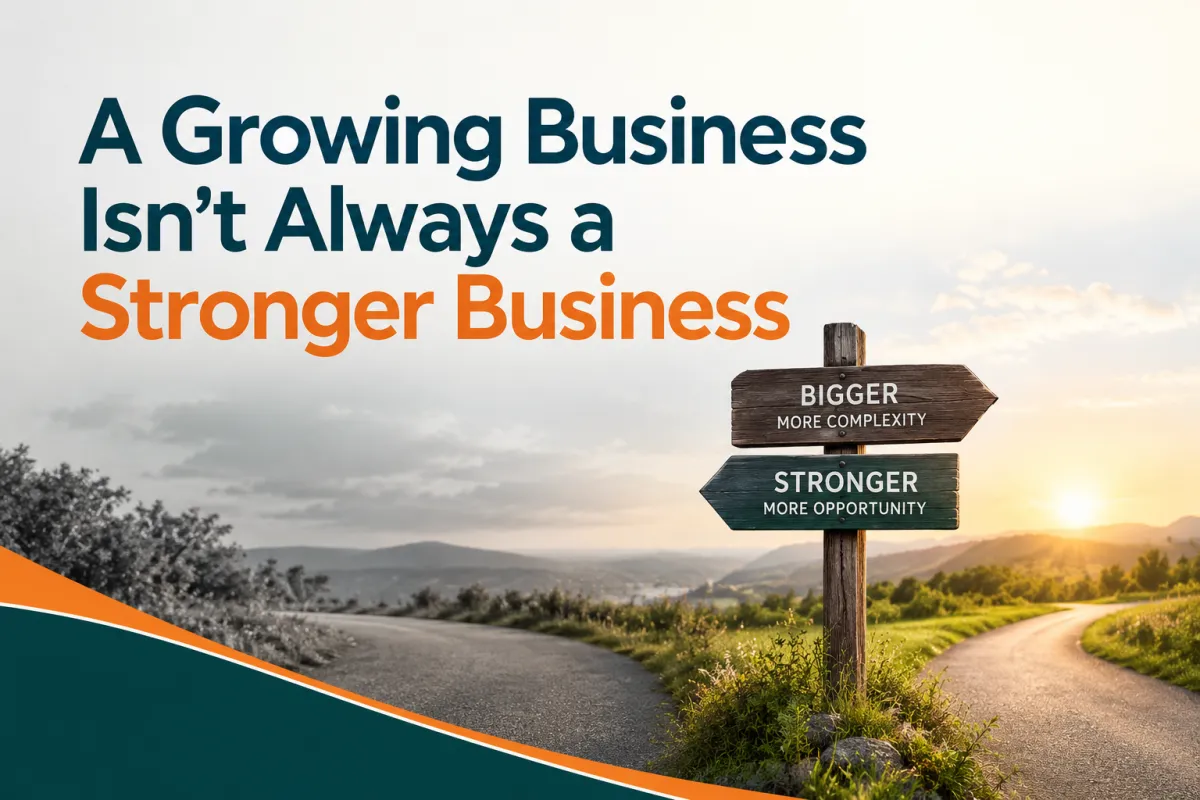
A Growing Business Isn’t Always a Stronger Business
Ask a business owner how business is going and one of the common responses you often hear is “We’re really busy”. Some will follow up with “We added three customers last week” or “We’ve employed two new staff”.
Conventionally, we see an increase in size as a measure of success. We measure success through growth in revenue, customer numbers, staff and similar indicators. These can be positive signs of progress. But they don’t necessarily tell us if the business underneath has become stronger.
What worked at one size may not work at the next
When a business is smaller, few people can hold much of the knowledge, information and credentials. Informal processes may work and the owner can personally oversee most things.
As the business grows, those same practices can become weaknesses.
Knowledge held by one person will put pressure on that person, the load may need to be shared. When the team grows because of extra work, having one person holding all the knowledge about processes and systems in their head will create inefficiency and bottlenecks.
When the business was small, the person preparing the quote may have known all the details required to quote; how long a job takes from start to finish and who is the best person to carry out parts of the project. As the business grows, that knowledge becomes harder to manage as more people are involved.
Documented processes that are accessible to the people who need them can make work efficient across the business. What if you have to wait for the owner to approve every step of a process? How efficiently will the work ever reach completion?
Growth consumes resources before the benefits necessarily appear
Imagine a manufacturer currently producing 1,000 units a week. The business receives an inquiry to supply 10,000 units. Unless you plan, organise and build the capacity to produce that before the proposal is accepted, delivering the products on time will be nearly impossible.
You will need to source the materials and determine how you will create the additional capacity to deliver on time. Most of these will require funding before you can invoice the customer and get paid.
Growth can magnify what is already happening
If the business is operating on good margins, growth can amplify that. On the other hand, if the business is run on poor margins, then growth will amplify those poor margins.
If you already have efficient processes, growth will leverage them. If your processes are inefficient, growth will magnify inefficiency.
If responsibility and decision making is shared across a team, that management capability will grow, whereas a business that relies on the owner for everything will become even more reliant on the owner when that business grows.
What’s happening underneath the growth?
If your business has grown in the last 12 months, what have you noticed alongside that growth?
Have margins strengthened?
Has cash flow improved?
Are systems keeping up with the pace of growth?
Can decisions be made without everything coming back to the owner?
Is the business becoming easier or harder to run?
When growth doesn’t feel like growth
I’ve had business owners tell me they are very busy, revenue has increased and money is coming in, yet they have nothing left in the bank to show that growth.
One service-based business told me that they did everything their coach asked them to do, yet they can’t see results from the extra sales the business generated that year. All they saw was the money going out as fast as it came in.
The issue wasn’t necessarily the growth itself. When we discussed further, there were other things happening underneath the growth - systems, pricing and overheads all needed attention. More sales alone weren’t going to address all of those issues.
So, did the business grow? Absolutely.
Did it become stronger? That’s a different question.
Growth can expose weaknesses
Growth can magnify weaknesses that were manageable when the business was smaller. More work doesn’t automatically give you more profit; it can mean doing more work without knowing where you’re making an adequate return from it.
I’ve seen businesses where important knowledge sits with one person, quotes are prepared based on what that person knows from experience, but the actual time spent on the work isn’t recorded or compared with what was quoted. As more work comes in, it becomes harder to know whether the extra activity is actually producing the expected return.
The same applies to processes. A workflow that hasn’t been properly thought through, documented or explained to the people responsible for carrying it out may be manageable at a smaller volume. Put significantly more work through that same process and the weaknesses can become much more visible, and more costly.
Think about your own business in the past 12-24 months:
What’s grown?
What’s improved?
What’s become difficult?
If the business continues growing in the same way, where will that leave you in another two or three years?
The key is not to stop growing but to grow intentionally
Know why you are growing
Understand what the growth is producing
Build the capacity underneath it
Measure more than revenue
Make sure growth is strengthening the business rather than simply increasing activity.
What is your growth actually building?
Growth can be a positive sign of progress. But the question is not how much the business has grown, but what’s built underneath that growth.
Stronger margins. Better processes. Greater capability across the team. Less reliance on everything coming back to the owner.
Because ultimately, what you build into the business along the way will influence the choices that business gives you in the future.
That’s something we’ll be exploring further in our Build for Choice master class later this month. More details coming shortly.
Ready to review whether your current business design still supports what you want to achieve? Explore our insights and strategic resources for business owners at towardsgrowth.com.au.
© 2024–2026 Towards Growth. All rights reserved.
Towards Growth is a strategic business advisory and mentoring practice.
The ideas, insights and client stories we share come from our own work and practical experience, with AI used for editorial support.
The Revenue-to-Value Model™ is a proprietary framework of Towards Growth.
